Review by Boris Groisman
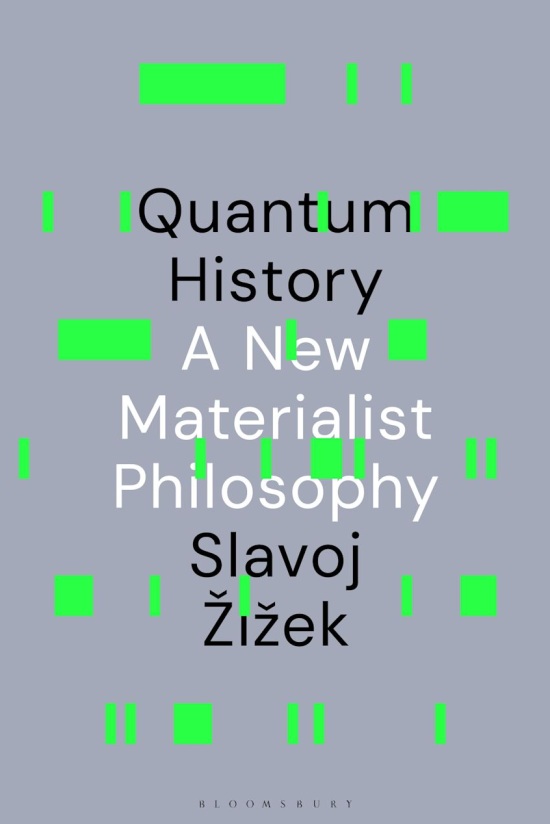
In Quantum History Slavoj Žižek presents a systematic attempt to revise the ontological foundations traditionally associated with Dialectical Materialism by critically examining the underlying assumption that reality and historical development are determinate and linearly constituted.
Drawing on resources from quantum mechanics, psychoanalysis, and continental philosophy, the book advances the thesis that both reality and history are essentially open, indeterminate and retroactively constituted. Consequently, political praxis should not be grounded in claims of necessity or certainty but must instead acknowledge contingency as its operative condition.
A materialistic philosophical outlook is often regarded as a natural ally of science. However, a paradox emerges within the achievements of scientific progress. As scientific inquiry delves further into phenomena that defy common sense and into theories that challenge established conceptions of reality, the appeal of spiritual or idealistic interpretations intensifies. In the presence of unresolved mysteries, there is a tendency to substitute rational analysis with metaphysical explanations. The question arises whether philosophy can protect science from the allure of spiritual and idealistic interpretations.
Žižek appeals to Lenin’s Materialism and Empiriocriticism as an example of ‘a materialist reply to attempts by obscurantist philosophers to give spiritual twist to new scientific discoveries…’ (p. 2) Lenin recognized the need to reformulate materialist philosophy following scientific breakthroughs. Similarly, one century on from the birth of Quantum Mechanics, Žižek draws on quantum mechanics to rethink materialism. He critiques spiritual or vague interpretations of quantum mechanics and asserts the necessity of philosophical engagement with its ontological implications. He argues that quantum theory challenges classical notions of a deterministic, fully knowable universe, and instead points toward a dialectical materialism that embraces contradiction, uncertainty and continual emergence.
Žižek, thus, frames the book’s core argument: reality is inherently “cracked,” indeterminate, and shaped by observation, not just politically but existentially.
Part I of the book – Universal: Collapse comes first – lays the foundation for this argument. It connects quantum notions of indeterminacy and wave-function collapse with Hegel’s dialectical movement and ontology. The author’s central claim can be reformulated as follows: both Hegelian dialectics and quantum mechanics exhibit a common structural feature, namely, the rejection of pure determinism. In neither framework do events simply unfold; rather, they involve discontinuities – what in the quantum context are termed “collapses” – that not only determine the present configuration but also retroactively inform the interpretation of prior states. From this angle, the quantum paradigm emerges as an antidote to deterministic historicism, preserving the dialectical insight while avoiding its reduction to necessity.
Žižek then flips the previous argument, showing how dialectical philosophy enriches our understanding of quantum ontology. He explores how quantum indeterminacy aligns with Hegel’s concept of contradiction. Indeterminacy becomes contradiction in motion – the unresolved, ‘sublated’ tension that drives becoming itself.
Further, Žižek draws a striking parallel: just as quantum noncommutativity makes the sequence of operations matter, so too the structures of language, ideology, and society are inherently non-linear. Symbolic orders are not smooth chains but fractured terrains, where radical contingency does not merely disrupt reality – it constitutes it.
In Part II – Particular: From Hegel to Heidegger… and Back – Žižek explores the concept of finitude – existential and historical – through the lenses of Hegel, Heidegger, and Robert Pippin. For him, being bound to time exemplifies a kind of quantum‑like contingency: our choices matter precisely because the course of history is not fixed in advance. The text proceeds with a philosophical dramatization of existential void and historical contingency. Žižek draws upon Heidegger’s concept of “the night” to characterize the abyssal and indeterminate space in which facts, meanings, and political contexts converge in a state of ongoing flux. Subsequently, the analysis shifts to political considerations. Žižek presents a contentious reinterpretation of Heidegger’s political philosophy, framing it in terms of finitude and quantum contingency. In this view, politics arises from uncertain existential conditions rather than from predetermined socio-economic developments.
Part III – Singular: Politics in a quantum world – applies the concept of holography, where each part encodes the whole, to the analysis of political universalism. Žižek argues that contemporary politics is defined by competing universal claims, including human rights, nationalism, and global capitalism, which intersect but never completely align. Quantum models are employed to demonstrate that universality is inherently partial, fragmented, and contested. Žižek proceeds to investigate artificial intelligence to distinguish between symbolic processing and authentic subjectivity. By comparing AI to quantum indeterminacy, he maintains that AI lacks the constitutive negativity, inconsistency, and self-division that define human cognition. This analysis relates technological debates to historical materialism and the question of political agency.
The main part of the book is followed by nine Variations, which would take this review beyond reasonable length.
How might a critical reader receive this book?
Quantum-mechanical outlook lies at the heart of this work. Žižek positions his project as a radical re-examination of materialism, engaging philosophically with the ontological implications of quantum mechanics. However, there is currently no consensus on quantum ontology – physicists still widely disagree on what quantum mechanics reveals about the nature of physical reality. In seeking alignment between quantum mechanics and Hegelian philosophy, Žižek favours those interpretations of quantum mechanics that support indeterminism, and he places the primacy of wave-function collapse as the foundation of his analysis. [For a contemporary review of deterministic and indeterministic interpretations, see (Vaidman, 2024)].
I propose that the reader may interpret this in two alternative ways.
On one hand, it is possible to understand Žižek as implying that the ontological interpretation of a physical theory can be determined independently of the theory itself – that is, through philosophical analysis. Within this framework, particular interpretations of quantum mechanics would be privileged if they are consistent with the broader philosophical system being adopted.
On the other hand, one may read Žižek as mobilizing quantum theory not as a literal account of physical reality but as a metaphorical and conceptual resource. In this view, quantum mechanics functions less as a literal description of the physical world as it is than as a philosophical instrument for interrogating deep-seated metaphysical presuppositions. It becomes a means of destabilizing naïve realism and demonstrating that the symbolic order – comprising language, ideology, and shared conceptual structures – plays a constitutive role in shaping what is apprehended as reality.
The book remains vague about which of the two views it ultimately supports. Various examples and statements oscillate between the two, occasionally supporting both.
To give an example, the first view is supported by Žižek’s position on the status of quantum collapse: ‘… the very idea of a collapse as an actual physical event is considered problematic… I prefer to insist that collapse has to be accounted for in terms that are imminent to quantum waves. … I am therefore opposed to all readings of quantum mechanics which ignore this priority of collapse, to all the narratives how collapses arise from the spontaneous imminent development of wave oscillations [various collapse models, BG], as well as to all attempts which take the opposite path and reduce quantum reality to an effect or aspect of our ordinary reality [in particular, de Broglie-Bohm and Many Worlds models, BG].’ (pp. 13-14)
Moreover, drawing on the perceived time asymmetry of collapse, Žižek introduces his notion of ‘para -consistent temporality in which a collapse into our ordinary reality retroactively posits the wave function.’ Those who are familiar with the time‑symmetric (or two‑state) formalism of quantum mechanics – developed by Yakir Aharonov and collaborators – which treats quantum processes as fundamentally symmetric under time reversal will be puzzled by this ontological link between collapse and time asymmetry. This is because the two-state formalism breaks the link between collapse and the arrow of time.
As a second example, consider Feynman’s famous image of the positron as an electron tracing its path backward through time (pp. 15–16). In Feynman’s construction, two particles – electron and positron—merge into one: a single trajectory that, at a certain juncture, reverses its temporal course. Here, particle-antiparticle duality evaporates; what we confront is one and the same entity, folding back upon itself. This ‘retro-causal’ interpretation is appealing from Hegelian standpoint: ‘… something which appeared to be another positive element of reality (positron) turns out to be something which differs from its opposite only because of its different temporal line. And is this not also a proper way to reject the dualism of good and evil?’
This is an elegant construction, one must admit, but the dominant view among physicists today is that Feynman’s idea is interpretative rather than ontological, i.e. it is a mathematical reinterpretation, not a claim about the actual trajectory of particles in spacetime. Positrons do not physically reverse the arrow of time in the sense of violating thermodynamic or causal order. Instead, the “backward in time” language merely simplifies calculations and preserves symmetry, not a literal reversal of temporal flow. For this reason, some physicists prefer to avoid the time-reversal language altogether, framing antiparticles simply as distinct excitations of the same quantum field (i.e. distinct elements of reality). This avoids metaphysical confusion. If one accepts that Feynman’s construction is merely interpretative, then it weakens the link between ontological foundations of quantum mechanics and those of dialectical materialism – the main project of the book.
Žižek himself admits that he cannot vouch for the scientific validity of the above presentation and that of all he is saying is that it works perfectly from the Hegelian standpoint (p.16). At the same time, he adds ‘We can see from this example how Hegel’s thought can make a crucial contribution to quantum theory, supplying a dimension which has been lacking’. This makes an impression that not only does he believe that, via Feynman’s example, quantum theory can enrich philosophy, arguably just metaphorically, but that philosophy can enrich quantum theory by adopting a (disputed) ontological stance.
A further illustrative case is the delayed‑choice quantum eraser experiment, ‘which appears to imply an influence of the future on the past’ (p. 17). Although frequently invoked as emblematic of quantum mechanics’ counterintuitive features, its prominence owes more to popular exaggeration than to the actual physics involved. While the setup does contain several subtle points of conceptual interest, its widely publicized implications rest on a mistaken line of reasoning and have been definitively refuted in the literature: the experiment neither erases which‑path information nor retroactively alters the particle’s past.
There are several other examples throughout the book the suggested ontological interpretations of which are likely to be disputed by some physicists.
Žižek employs Rovelli’s Relational Quantum Mechanics (RQM) as a physical model to support his broader epistemological and political arguments. He examines Anton Zeilinger’s Nobel-winning experiments through the lens of RQM (pp. 59-64). The book asserts that these experiments ‘demonstrated that two entangled particles can exchange information faster than the speed of light’. However, many physicists contend that the term ‘information’ lacks precise definition in this context. While entangled particles display correlations that appear instantaneous, such phenomena do not contravene relativistic causality, as no usable information or signal is transmitted faster than the speed of light. Therefore, Rovelli’s counter-argument appears to be misplaced. The claim that the absence of universal simultaneity prevents simultaneous measurement of two distant entangled particles is unsubstantiated, since a reference frame always exists in which such measurements are simultaneous while they would still remain space-like separated in all other frames. The necessity of waiting for a signal from A to reach B is also questionable, given the existence of conceptually and mathematically well-developed techniques for instantaneous measurements of non-local variables [see Aharonov, Albert, Vaidman (1986)].
Thus, here lies the book’s vulnerability: a critical reader familiar with foundational debates in quantum mechanics is likely to conclude that Žižek uses the logic of (certain interpretations of) quantum mechanics as a mere philosophical metaphor to argue that reality – physical, social, and subjective – is fundamentally contingent, fractured, and defined by structural gaps, undermining deterministic or mechanistic forms of materialism. Yet the book also hints at a more direct, literal ontological connection to the quantum level of reality (which is by itself a part of physical reality). However, under critical examination, the examples given in the book overall fail to provide convincing support for this latter perspective. (Quantum mechanics is mysterious, but it is not nearly as mysterious as some try to portray it.)
At the same time, a critical materialist will appreciate Žižek’s critique of the recent trend to explain consciousness through direct connections to quantum mechanical processes. The Penrose-Hameroff model, often cited as the most prominent example, seemingly adopts a materialist stance but ultimately reveals idealist assumptions (p. 44).
To summarise, this book is an inspiring and thought-provoking work. I found it extremely stimulating, though quite challenging to read due to its sheer length and high density of concepts, coupled with frequent shifts in focus, which at times obscure the underlying line of argumentation and make it difficult to identify a coherent progression of reasoning. Nevertheless, engaging with the text prompted me to reflect more deeply on the issues it raises. I have learnt from it a good deal.
Quantum History: A New Materialist Philosophy by Slavoj Žižek
Bloomsbury Publishing ISBN 9781350566422 Hardback 456 pages
Dr Boris Groisman is College Associate Professor, Worth Waynflete Foundation
Fellow and Taylor Lecturer in Mathematics
Sidney Sussex College Cambridge
 International Friends of Ilyenkov